The Best Rope

Money Can Buy

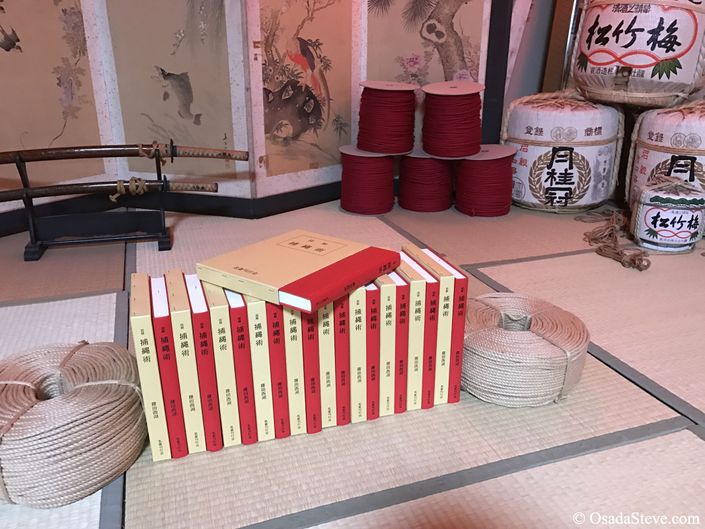
Osada Jute rope (asanawa, 麻縄) is made under strict quality control using a 'well-kept secret' formula.

Using the finest jute, this rope is tailor-made for tying people, not parcels.


Often imitated, never duplicated.


A word on JBO (= Jute Batching Oil)


Jute batching of the Osada Jute rope is done with vegetable oil (100%).

Rope from the hardware store or high street vendors is different because that rope isn't meant for kinbaku/shibari or bondage. Such rope is usually batched with (carcinogenic) mineral oil that may cause skin allergies and usually comes with an irritating 'gasoline' smell.

Choose a Pricing Option

Osada Steve on Rope

Coil Like Osada Steve

As evidenced by the jumbo-length video clip above, once Osada Steve gets coiling, nothing will stop him.

The beauty of this method is that once coiled the rope easily fits into pockets of samue (作務衣) getups or into the sleeves of male kimono.


What You Always Wanted To Know About
Rope in Kinbaku/Shibari (緊縛/縛り)
It’s a free country. You and I have the constitutional right to use whatever type of ‘rope’ (cotton, polypropylene, barbed wire) in whatever diameters (4, 6, 8 mm or even more) in whatever lengths (1m, 4m, 8m, 16m, 50m) we choose.


Yet, if it’s Kinbaku/Shibari (緊縛/縛り) you are into, it helps to understand a few points. In ‘true’ shibari, we use jute rope with a diameter of 4.5 to 6 mm, and the standard length is 7 to 8 meters. If this comes as a surprise, chances are you have never been to Japan or that your knowledge of Japanese rope art lacks authentic provenance.


A standard tatami () mat is 6 x 3 shaku (). Two tatami are 6 x 6 shaku or 1 tsubo () = 3.3 m2. A shaku is about a foot (30cm). If you run a rope around 2 tatami, you will get 4 x 6 shaku (or feet) = 4 x 1.80m = 7.20m, which is the old-days, old-school rope length in shibari. In the old days, if you took a riksha to the rope market and asked for a length of rope, you would be handed a shank of 24 shaku (= 7.20 meters). Fast forward to the modern age, where a healthy diet has made ‘man’ grow larger: just add another shaku or two to account for 'modern' body sizes. Today, with 8 meters, Bob's your uncle.


The significance of 6 shaku (1.80 meters) can also be found in Japanese architecture, where the height of sliding doors corresponds to the length of tatami (1.80 meters again), or the height of the door beam (1 ken, 間), which any Westerner having bumped his head in Japanese housing can attest to.
Six shaku (, 1.80 meters) are also equal to 1 hiro (, fathom) to measure nautical depth.
Six shaku (, 1.80 meters) also happens to be the distance between the fingers of a person’s outstretched arms, which, surprise, surprise, corresponds to the height of that person – provided you are of ‘standard’ proportions – something that Leonardo da Vinci had discovered back in 1485 on that fateful sunny Wednesday afternoon in May.


Japanese Units
1 shaku () = 1 foot = 30cm = 10 sun ()
1 ken () = 6 shaku () = 6 feet for the room dweller
1 hiro () = 6 shaku () = 6 feet = 1 fathom for the seafarer
1 jô () = 10 shaku ()
1 tatami () = 0.91 x 1.82 m = 3 x 6 shaku () = 1.65 m2
1 tsubo () = 2 tatami () = 3.3 m2
1 gô () = 180 ml or cc (a typical size for serving sake in restaurants, and also to measure a person’s amount of rice per meal)
Bottle of rice wine = 1.8 liters
Sake barrel = 18 liters, 36 liters, and larger
1 koku () = 180 liters
The Vitruvian Man (c. 1485)


Now that you know all about the type, diameter, and length of rope in Kinbaku/Shibari (緊縛/縛り), you can get your very own rope fix by ordering genuine Osada jute from Japan.


On Rope Treatment

Based on a secret formula, Osada Jute is tailor-made for shibari/kinbaku (縛り/緊縛).

Osada Rope does NOT require treatment.

It will become smooth as silk simply by use.

The more you tie, the smoother it will get.

Lesser-quality rope often requires an elaborate and time-consuming treatment regimen to be beaten into submission.


The Osada Jute is relatively light in color because of the purity of its fibers.

Lesser-quality rope often contains impurities that make it look darker.


If you wish, you can run your rope over a flame.

This will burn off 'fluff' and also achieve a darker color. After such a process, you would want to reintroduce moisture by running your rope through a cloth with tsubaki or bayu oil.

Avoid concoctions that may cause rancidity.


Keep your rope away from water (and other liquids).

NEVER wash your rope!

Otherwise, your rope will lose its energy, and it will be reduced to the life of a wet noodle.